Thursday, October 27, 2011

Goodbye to the Land of Enchantment

I'm posting from the Sunport, the Albuquerque airport.  We're hanging out, drinking coffee and connecting once more before we fly away home.  And the sun has returned to New Mexico after the rain and snow.

The weather changed our plans and got us to Taos Pueblo ahead of schedule, and that was so fortuitous because we were able to take the time to enjoy more of the Land of Enchantment.  

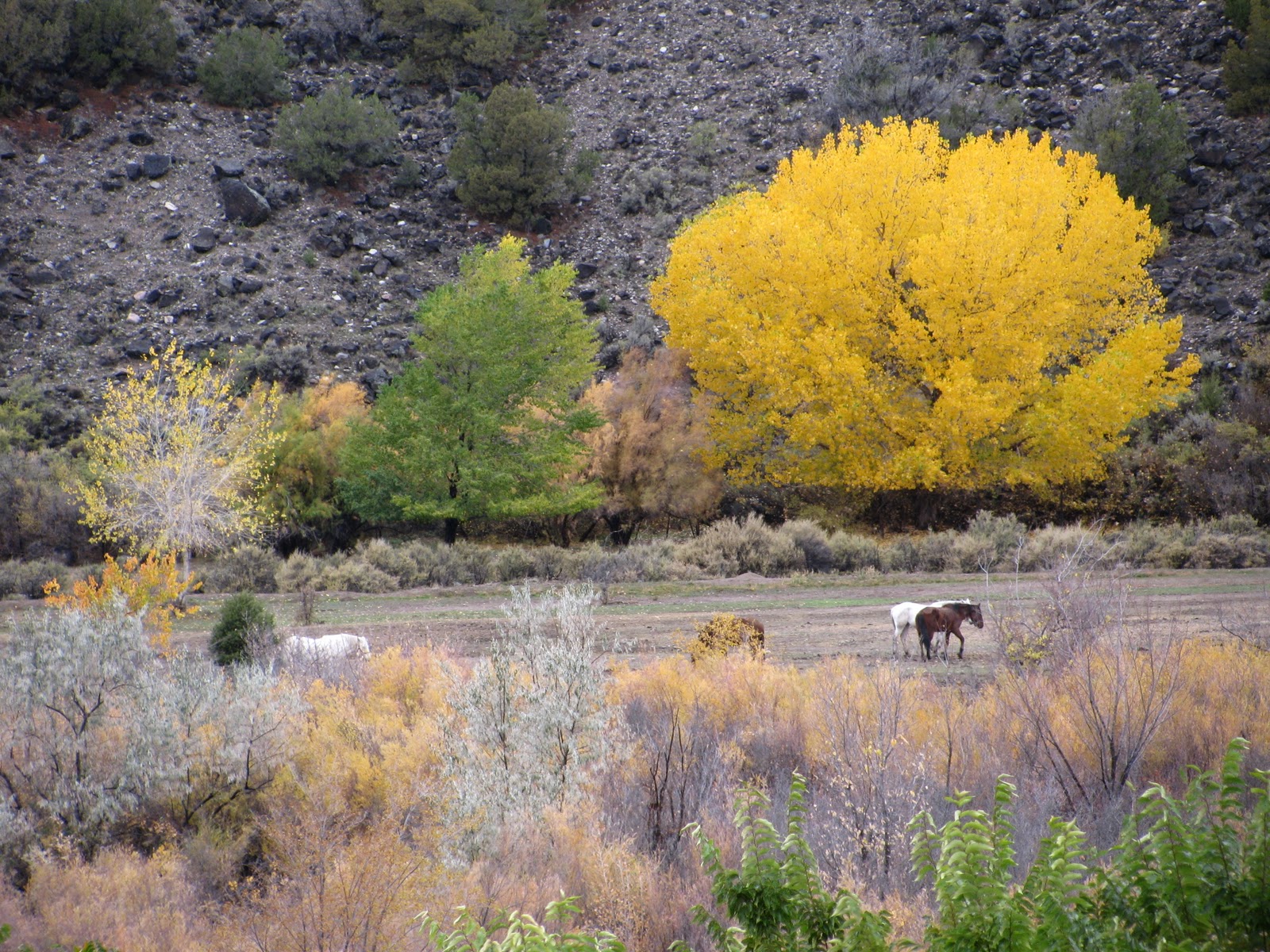
The drive through the Rio Grande Canyon, and a side trip off the main road, was one glorious mile after another! 


 We had time to go back to Santa Fe and give more time to Canyon Road, with its galleries and sculpture.


Of course we started with this shop, which deals in Indian crafts.  It's housed on a 250-300 year old hacienda, and is full of treasures.
 The gallery tender recommended this old taverna for lunch.  I had pozole clam chowder.  Yum!
 Canyon Road scenes.


Adios New Mexico.  We were indeed enchanted!

Wednesday, October 26, 2011

Taos

The big news in northern New Mexico this morning was the weather.  A cold front had moved in bringing scattered rain and the potential for snow in the northeast.

As it turned out, Colorado got dumped on with the snow, and we got rain.


It was just drippy as we headed north of Santa Fe and picked up the route called the High Road to Taos.
 Our first stop was in Chimayo, an old Spanish settlement with some historic buildings, and famous weavers.  The Ortega's have been weaving here for eight generations.


 We bought a table mat 'rug' as a sample of their beautiful work.  


The next stop was to be Cordova, noted for its wood carvers, but I'm afraid we got lost in Codrova.  Is the road?
 We never found any wood carvers, but it was an adventure, and quite scenic too.
 The next town, Truchas, is a sort of ramshackle artist colony.  We stopped at one gallery, where the elderly gentleman almost talked our ear off, but he was quite charming.  We learned that Truchas means 'trout'. Elevation, 8000 feet.
 There wasn't much of a town in Las Trampas, but there was this wonderful old church, built in 1760.
 And finally, we were in Taos.  Actually, we moved right along this morning because with the weather an issue, we wanted to get to Taos Pueblo this afternoon.  We visited some of the shops around the plaza.
Then we had lunch at the Taos La Fonda Hotel on the plaza. I had a salad and a bowl of pozole, a pork and hominy stew that was new to me until this week, but that I have become quite fond of.
 After lunch we drove out to Taos Pueblo.  It was raining off and on, and the plaza was turning muddy, but we pressed on.  We found quite a few fellow travelers there.

 We have had many wonderful experiences on the trip, and this visit is right up there on the top of the list.

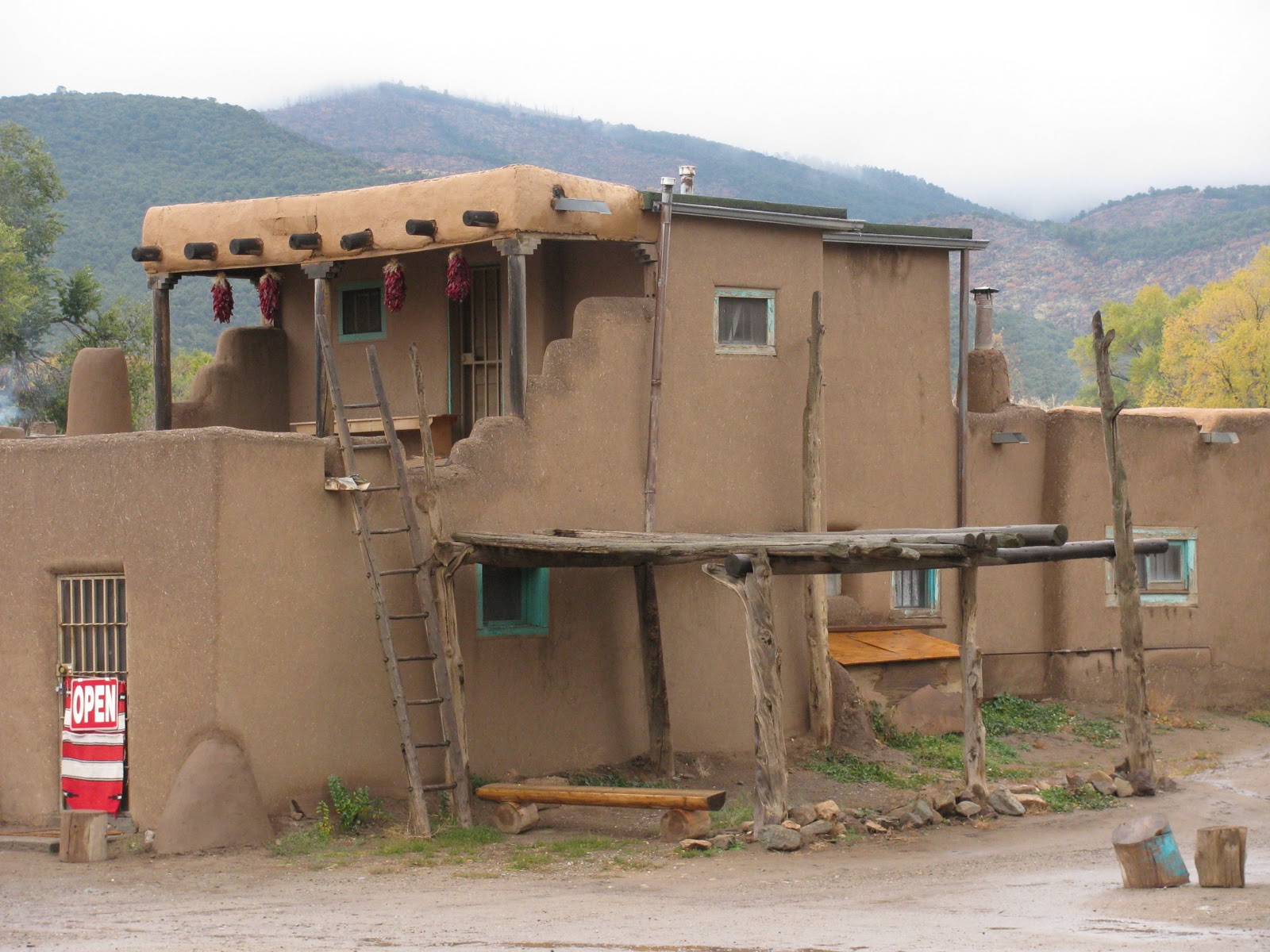
 This is the stream that runs through the center of the plaza, separating the two main apartment style pueblo structures.  These buildings are up to 1000 years old.  Taos means 'red willow', such as the shrubs here on the stream bank.


See that Crafts sign, and the 'open' sign?  Well, there were lots of them, and they were a little hard on the pocket book.  We left with four more pieces of pottery. Of course we are not buying the big expensive pieces, and we did get some good deals, since the tourist season is over.

 The rain let up after a while so we could enjoy being out in the open.


 This friendly rez dog greeted us on our arrival and then escorted us in our departure.
 We have visited many pueblos now, and they can seem to be pretty dismal places to live.  But there is beauty in simple things.
 And the real beauty is in the people.  We had so many wonderful conversations with so many artisans and their family members.  We learned from them as we appreciated their skill and craftsmanship.  We shared experiences of our life in Seattle.  Many had spent time in the PNW, either on reservations or in the military.


In fact,we even made a family connection.  One painter had spent time on the Yakima reservation and in Toppinish in eastern Washington State.  Tom mentioned that his cousin's husband was a doctor in Toppinish, and his father and uncle had been doctors there for many years before.  Turns out that the elder Dr. Shearer delivered this woman's daughter 39 years ago!


On our way back to Taos, we stopped at this Women's cooperative gallery.  There we met Judith Tofoya, of the famous Santa Clara/ San Ildefonso Tofoya potter family.  It was her old aunt we visited a few days ago.  Judith was working on one of her famous carved pots, and her daughter was working with her.  Judith is a master potter, and a very small black on black pot of hers was priced at $300.  But the wonderful conversation we had with her was priceless.
Tomorrow our trip comes to an end.  We have all day to work our way back to Albuquerque, where we will board our flight home at 5:30.  

It has been an amazing trip. 

Update:  It's now snowing in Taos!  good thing we have all day to travel tomorow.

Tuesday, October 25, 2011

The Jemez Mountain National Scenic Byway

After a quick stop at a nearby Albertsons to pick up road lunch supplies, we were on our way north and then west of Santa Fe.  Our plan to visit Bandelier National Monument was somewhat complicated by the fact that the monument was closed to private cars.  The fires in the area had led to huge erosion problems when the rains came, and much of the parking area was washed out.  So we had to wait for shuttle service in White rock and then take the slow bus.  It added an hour to our itinerary, so we had to adjust later in the day.

But Bandelier was certainly worth the hassle. 


This valley, and many in the area, were heavily populated by the Ancestral Puebloans.  Their great house, great kiva, and cliff caves and dwellings line the walls of the volcanic tufa cliffs.


I loved this rock.  It is natural but looks so like a stone totem guarding the ancient dwellings.
There was some more scrambling to do, but most of it was paved steps carved out of the cliff.

We took the nature trail back through the cotton woods where only in August a raging torrent had raced through,

We took the shuttle back to White Rock, got our car, and then retraced our route past Bandolier and on along Hwy 4.  We stopped at a forest camp to eat our lunch, in an area that was part of the huge burn last June.
Much of the pine forest, dotted with aspen, showed signs of burning until we got to the Valles Caldera National Preserve. 
This meadow is the result of a huge volcanic collapse.
Turning south on Hwy 4, we entered the Jemez River valley.  This is Battleship Rock.
Scenes along the road in the Jemez river Valley.

We have been admiring Jemez pottery everywhere we go, so now we had a chance to see where it comes from.  The pueblo had a very nice visitors center.
What an amazing location their pueblo sits on!  Mountains and a river valley on one side...
and red rocks on the other.
As we drove out of the valley and turned back east and then north back to Santa Fe, we stopped to visit the Zia Pueblo, which had a small museum displaying some of their wonderful pottery, and Santo Domingo, which we drove through a small portion of.  Neither allowed photographs.
As a scenic byway, this drive did not disappoint.

Monday, October 24, 2011

The Northern Pueblo Tour

 We have been admiring and studying pottery for many days.  Today we set out to meet some of the makers out in the pueblos where they live.

 First on the route is Tesuque Pueblo, a very traditional pueblo with little contact with the outside world.  We got permission to drive through part of the village, but no photos are allowed.  I did take this lovely scene on the road into the pueblo.

 San Juan Pueblo had a bid casino and hotel, but nothing of the old pueblo structures or even a visitor center.  They do have this lovely view of the Rio Grande Valley.
 Pojoaque Pueblo has a visitors center museum with a wonderful gallery on New Mexican pottery.
 This was a lovely structure with a great short diaramic history of the pueblo peoples.
 Several Pojoaque are wonderful sculptresses.
 Santa Clara Pueblo is known for their black pottery. They commonly use the Water Serpent figure in their decorations.
Santa Clara is open to visitors and potters display and sell their wares from their own homes.  Just look for the Open signs.


Corn, his first name, is actually a Zia/Hopi living at Santa Clara.  We had fun talking to him, an old guy with a weathered face.  We bought a small pot from him.
 I didn't get a photo permit here, so I just took a few non-personal photos.  We did go into several gallery homes, and had some wonderful conversations with potters.  One elderly woman was burnishing a pot with an agate stone and worked while we watched.

 The Rio Grande Valley is very scenic.
 The ancestral Santa Clarans lived in cliff dwellings in the edge of the valley.


 San Ildefonso Pueblo is famous for its most noted potter, Maria Martinez.  She revived and perfected the dung fired black on black pottery.
 This wonderful old cottonwood, the grandfather tree, sits in the plaza.

 The view to the river.
 The San Idelfonso emblem is fairly new, derived from a combination of bird features.
 The pueblo museum has displays of Maria and some of her pots, as well as family members of hers, and other famous potters from this village.  In another gallery we watched a video about Maria and the technique of making coil pots, slip glazing them, painting the designs, and then firing them in a juniper/cedar fire covered with cow chips and powdered horse dung.  The cow and horse dung creates the black color.
 Another famous potter of the village is Juan Tofoya.  While he has been gone quite a while, his sister carries on.  We found her in her gallery/home sitting with a pile of powdered clay.  She told us she had just mixed in the volcanic ash and had it ready to add the hot water - after the tourists leave today.  Tomorrow she will be making pots which will then dry in the sun before being decorated and fired.  She was great to talk to.
We had a great day and learned so much.  It was a rich experience!